

Table of Contents
Still confused between Gutenberg vs other WordPress page builders? This guide has got you!
Till this date, WordPress powers over 40% of all the websites on the internet while handling more than 20 billion monthly page views across 455 million live sites.
The only reason we stated all facts is due to those users who still search “Is WordPress still used in 2026?”. So, the answer must be crystal clear that making websites with WordPress is still the best option.
Now for creating a WordPress site, you need a page builder. And luckily, WordPress offers a default one with no extra cost – Gutenberg.
Although designed to be easy-to-use, still many find the block-based interface complicated and limited if the goal is to create an unique eye-catching site. Thus they look for other WordPress page builders.
At WPNext, we’ve worked on almost every WordPress page builder, whether it be Gutenberg, Elementor, Divi or Beaver Builders. So we think we’re the best to answer your question and remove your confusion between Gutenberg vs. Page Builders for WordPress.
Stay tight, and let’s get started!
Gutenberg vs. Page Builders: Quick Comparison
Don’t have time to scroll? No worries! Here’s the head-on-head comparison of the Gutenberg vs. WordPress page builders
| Feature | Gutenberg (Block Editor) | WordPress Page Builders (Elementor, Divi, Beaver Builder, Brizy, etc.) |
| Built Into WordPress. | Yes, included by default. | Requires a plugin. |
| Cost. | Free. | Usually free with premium upgrades. |
| Ease of Use. | Moderate learning curve due to blocks. | Beginner friendly drag and drop editing. |
| Design Flexibility. | Good for most websites. | Extensive design controls and customization. |
| Performance & Speed. | Lightweight and optimized. | Can add extra CSS, JavaScript, and page weight. |
| Core Web Vitals. | Generally performs better. | Depends on builder and optimization practices. |
| Accessibility. | Follows WordPress core accessibility standards. | Varies by builder and implementation. |
| Scalability. | Excellent for growing content heavy websites. | Good, but large sites may require additional optimization. |
| SEO Friendliness. | Clean code output and minimal overhead. | Good, but performance optimization becomes more important. |
| Template Library. | Limited compared to builders. | Hundreds of ready made templates available. |
| Landing Page Creation. | Basic to intermediate. | Advanced marketing and landing page tools. |
| WooCommerce Design. | Improving rapidly with blocks. | More visual control over store pages. |
| Developer Friendliness. | Uses WordPress standards and native APIs. | Varies depending on the builder. |
| Third Party Ecosystem. | Growing block plugin ecosystem. | Large ecosystem of addons and widgets. |
| Maintenance. | Fewer dependencies and updates. | More plugins and updates to manage. |
| Migration & Future Proofing. | Native to WordPress core | Switching builders can require additional work. |
| Best For. | Blogs, publishers, membership sites and performance focused businesses | Agencies, marketers, freelancers, and design heavy websites. |
What Is Gutenberg?
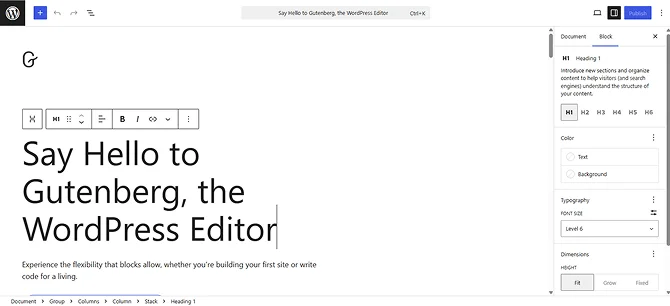
Gutenberg is the modern block-based editor for WordPress. It is WordPress default editor for creating web pages using individual “blocks”. It’s the same as building with digital Legos.
If you want to add a paragraph, an image, a heading, a video or a button, you can easily move, delete and customize as each element is its own block.
All you have to do is just drag and drop elements, change colors, and adjust layouts to the exact kind of website you want. No HTML. No CSS.
Apart from this, Gutenberg, now, has evolved into a full-site editor. Means you can now use the blocks to design your complete website including header, sidebar and footer, not just blog posts.
What Are WordPress Page Builders?

WordPress page builders, excluding Gutenberg, are third party plugins you can install to add drag and drop design interface. These are like external apps you install in your dashboard. Let them sit on top of your WordPress and design your complete website in real time.
Some of the most popular page builders you can use alongside or instead of Gutenberg are:
- Elementor
- Divi
- Beaver Builder
- WPBakery
And many more. We’ve used all these third party page builders and Gutenberg, so the difference between them is clear as day.
Gutenberg is native to WordPress and keeps your website lightweight and fast. On the flip side, page builders like Elementor gives you an extreme level of control over layouts, animations and highly customizable designs.
Gutenberg vs. Page Builders: What’s the Real Difference?
At first glance, Gutenberg and WordPress page builders seem to do the same thing: They allow you to build web pages without writing code.
But once you start creating real websites, the differences become much more noticeable.
Some website owners prioritize speed and clean code. Others need advanced design controls, landing pages, and drag and drop flexibility. And choosing the wrong tool….? Well, that’s not an option because that will lead straight to:
- Slower websites,
- Higher maintenance costs,
- Or limitations that become frustrating as your site grows.
Let’s compare them side by side.
Which Option Delivers Better Performance?

Website speed isn’t just a technical metric anymore. It affects SEO rankings, user experience, conversions and even how AI search engines evaluate your content.
In most scenarios, Gutenberg has a performance advantage because it’s built directly into WordPress. It generates cleaner code, loads fewer assets and relies on close-to-no third party apps.
On the flip side, WordPress Page builders such as Elementor, Divi, and Brizy offer more design flexibility. And that flexibility comes at a cost. Extra CSS, JavaScript, and database queries, fill your WordPress and affect your website site.
Although we also can’t deny that modern page builders have become way faster, they still generally need more optimization to achieve the same performance levels as Gutenberg.
Winner: Gutenberg
Which Solution Scales Better as Your Website Grows?

What works for a five page website will not work as well when your site grows to hundreds of pages, thousands of visitors or multiple contributors.
Gutenberg is built on WordPress core standards, thus far easier to maintain and scale over time. Large content websites, membership platforms, online communities and publishers mostly benefit from its lightweight architecture and long term stability.
But the WordPress page builders can also grow successfully for business websites and client projects. Yet again, larger sites will have to work extra for performance optimization and carefully manage multiple templates, widgets, and third party addons.
Winner: Gutenberg for long term scalability; Page Builders for rapid site creation.
Which Offers Better Accessibility and Compliance?

Accessibility improves usability for all visitors and helps websites meet modern compliance standards.
Because Gutenberg is developed alongside WordPress core, accessibility improvements are continuously reviewed and implemented by the broader WordPress community. Even the block system of it generally produces cleaner and more semantic HTML.
Page builders for WordPress also have improved in this area, however accessibility quality can vary depending on the builder, theme, templates and design choices used.
If accessibility is a top priority, Gutenberg provides the best foundation with less effort.
Winner: Gutenberg
Which Provides Better Value for Money?

At first look, Gutenberg appears to be the clear winner because it’s included with WordPress at zero extra cost. 100% Free!
For many blogs, small and growing business websites and content based projects, Gutenberg is all you need. It lowers both software expenses and ongoing maintenance costs.
However, don’t forget page builders offer free versions too (with limits of course). For advanced features only, you have to go for premium plans. The additional investment can be worthwhile if it saves development time or allows high-quality designs that would otherwise need custom coding.
Winner: Gutenberg for affordability; Page Builders for feature rich workflows.
Which Is Easier to Learn and Manage?

This is where the answer is mostly (not completely) on the user.
Gutenberg follows a block based editing approach that feels natural once you understand how blocks, patterns and templates work. But, some beginners find it less user friendly when creating complex layouts.
WordPress page builders, on the other hand, offers a visual drag and drop experience where you can see design changes in real time. This makes them easier for many beginners, marketers and designers to learn right away without hassle.
That said, simplicity can become complexity. As websites grow, managing dozens of widgets, templates and builder specific settings will need extra training and maintenance.
Winner: Page Builders for beginners; Gutenberg for long term content management.
When Gutenberg Is the Better Choice

Gutenberg is the better if you are:
- Running a blog, news site or content heavy website.
- Building a membership or community platform.
- Focused on Core Web Vitals and SEO performance.
- Looking to reduce plugin dependencies.
- Managing a website with multiple authors.
- Planning for long term growth and easier maintenance.
- Working with a limited budget and wanting to avoid recurring builder costs.
- Comfortable using WordPress’s native editing experience.
After all, a publisher with hundreds of articles will obviously benefit more from Gutenberg’s lightweight architecture than from a feature rich page builder.
Gutenberg Is Best For:
- Bloggers and publishers.
- Membership websites.
- Educational platforms.
- SEO focused businesses.
- Performance conscious website owners.
- Long term WordPress projects.
When a Page Builder Is the Better Choice

A page builder is the better choice when design flexibility, visual editing and faster website creation are your top priorities.
Thus go with a WordPress page builder (Like Elementor, Divi, Beaver Builder or Bricks) if you are:
- Creating custom landing pages regularly.
- Building client websites as a freelancer or agency.
- Designing visually complex websites.
- Launching marketing campaigns that may need multiple design changes.
- Managing a portfolio, agency or creative business website.
- Wanting access to pre-built templates and design elements.
- Prioritizing design freedom over maximum performance.
Apart from this, using any of the popular WordPress page builders means less time spent on custom development. Also, giving you a true drag and drop experience.
WordPress Page Builders Are Best For:
- Agencies and freelancers.
- Marketing focused websites.
- Landing page creation.
- Portfolio websites.
- Creative businesses.
- Users who want complete design control with no coding.
Final Verdict: Gutenberg or a WordPress Page Builder?
In closing, in this guide we’ve compared Gutenberg vs. page builders for WordPress. So if you’re still confused between which WordPress page builder to pick, let us give you a straightforward answer :
- If your priorities are fast performance, better scalability, good accessibility and future proof WordPress experience, Gutenberg is the best choice.
- If your priorities are design flexibility, visual editing and fast website creation, WordPress page builders are worth the trade off.
At the end of the day, the best option is the one that aligns with your website’s goals today and continues with tomorrow’s growth.
You May Also Like:
- The Beginner’s Guide to Choosing WordPress Page Builder
- Landing Page vs Website: A Complete Guide
- 5 Best AI Tools For Social Media to Boost Your Strategy
FAQs
Is Gutenberg a page builder?
Yes, Gutenberg is a default page builder and block editor for WordPress websites. Developed by WordPress, Gutenberg lets you design everything from blog posts to complete site headers and footers using a visual drag and drop block system.
Which editor is best for WordPress?
Here are all the best page builder editors for WordPress:
-Gutenberg
-Elementor
-Divi
Is Gutenberg better than Elementor?
Yes, Gutenberg is better than Elementor but only when it comes to website performance, site speed, clean code and native WordPress integration.
Is Gutenberg good in WordPress?
Yes, Of Course! Gutenberg is good and highly capable for creating WordPress websites.
Can I use Gutenberg and Elementor together?
Yes, indeed. You can use Gutenberg (The default WordPress block editor) and Elementor together. You can use Elementor for complex visual pages (Like your homepage, landing pages or contact page), and use Gutenberg for simple and content-heavy pages (like your blog posts).
Which is the best page builder for WordPress?
Gutenberg and Elementor are the best page builder for WordPress websites.
What is the fastest WordPress page builder?
Gutenberg paired with performance focused addon blocks like Spectra or Kadence Blocks is the fastest WordPress page builder.